Comparison with other packages
Python has a surprisingly large number of packages for working with physical quantities and units. This page compares the most popular ones with physipy — their design choices, strengths, and trade-offs — so you can pick the right tool for your problem. The aim is to be fair: physipy is not the best choice for every use case, and this page tries to make clear when another package fits better.
At a glance
| Package | Quantity model | Unit registry? | Angles as a dimension | Core dependency | Best suited for |
|---|---|---|---|---|---|
| physipy | wrapper (value + Dimension), not an ndarray subclass |
no — units are module-level objects | yes (rad, sr are base dimensions) |
numpy only | general scientific/engineering code that wants a lean, numpy-friendly library |
| pint | wrapper (magnitude + Unit), tied to a registry |
yes — UnitRegistry() required |
no (radian is dimensionless) | numpy optional | rich unit string parsing, contexts, the largest unit database |
| astropy.units | Quantity subclasses ndarray |
no | no | astropy (heavy) | astronomy, and equivalencies for non-trivial conversions |
| unyt | unyt_array subclasses ndarray |
module-level + registry | no | numpy | fast array-heavy work (born in the yt project) |
| quantities | Quantity subclasses ndarray |
no | no | numpy | a long-standing numpy-centric option |
| forallpeople | scalar Physical objects, auto SI rendering |
environment of units | no | numpy (light) | engineering calculations and notebooks (scalar-focused) |
| numericalunits | no type at all — units are float scale factors | no | no | none | zero-overhead code where you accept no dimensional safety |
| sympy.physics.units | symbolic expressions | no | no | sympy | exact/symbolic algebra inside a CAS |
The rows below explain the column choices in more detail.
How physipy is built (recap)
Understanding physipy's design makes the comparison concrete. physipy is built on two classes:
- A
Dimensionis a dictionary of exponents over the SI base dimensions. Notably, physipy includes plane angle (rad) and solid angle (sr) as base dimensions, alongside the usual seven (length, mass, time, current, temperature, amount, luminous intensity). - A
Quantityis simply a value paired with aDimension. It does not subclassnumpy.ndarray— it wraps a value, which can be a Python scalar, a numpy array, or other numeric-like objects. numpy compatibility is provided through numpy's__array_ufunc__/__array_function__protocols (150+ functions supported).
Two consequences follow, and they're the crux of most differences below:
- Wrapper, not subclass. Because a
Quantitywraps its value rather than being an array, the value type is flexible (float,Decimal, arrays,uncertainties/mcerpobjects, …), and physipy avoids the well-known pitfalls of subclassingndarray. The cost is that numpy functions must be explicitly supported (most common ones are). - Units are plain objects, not a registry.
m,units["mm"],constants["c"]are all justQuantityinstances. There is no registry to instantiate and no notion of incompatible registries.
The main alternatives
pint
The most popular units package. A Quantity is a magnitude plus a Unit, both
managed by a UnitRegistry that you must instantiate (ureg =
UnitRegistry(), then 3 * ureg.meter). Strengths: an enormous unit database,
excellent string parsing (ureg("3.0 m/s")), and contexts for
non-multiplicative conversions (e.g. spectroscopy). numpy is optional.
Versus physipy: pint's registry is powerful but adds ceremony, and quantities
from different registries don't interoperate; physipy's units are global objects
with no registry. pint derives dimensionality from registry definitions, whereas
physipy carries an explicit Dimension. If you need rich string parsing or
contexts, pint is the stronger choice today.
astropy.units
Battle-tested and excellent, but part of the (large) astropy project. Its
Quantity subclasses ndarray, so it behaves like an array everywhere. Its
standout feature is equivalencies — declarative rules for conversions that
aren't simple scalings (spectral, temperature, parallax, …).
Versus physipy: astropy is heavier and astronomy-oriented; subclassing
ndarray makes quantities drop-in arrays at the cost of subclassing edge cases.
physipy is standalone and lean, and wraps rather than subclasses. physipy has no
general equivalency framework (see Limitations).
unyt
From the yt project, focused on fast operations on large arrays.
unyt_array subclasses ndarray. Mature and performant for array-heavy
numeric work.
Versus physipy: same subclass-vs-wrapper trade-off as astropy/quantities. physipy's wrapper lets the underlying value be non-array types; unyt is specifically an array.
quantities
One of the older numpy-centric packages; Quantity subclasses ndarray.
Similar trade-offs to unyt/astropy, with a smaller feature set and slower
development pace.
forallpeople
Aimed at engineering workflows: it renders results in the most readable SI form automatically (e.g. combining into newtons or pascals) and is delightful in notebooks. It is primarily scalar-oriented.
Versus physipy: forallpeople optimizes for human-readable SI rendering of scalars; physipy targets general numpy-array computation with explicit favourite-unit control.
numericalunits
A fundamentally different idea: there is no quantity type. Each unit is just a (pseudo-random) float scale factor; you multiply on input and divide on output. This has zero runtime overhead and works with any numeric code — but it performs no dimensional checking. Errors are caught only statistically, by re-running with different random unit values.
Versus physipy: opposite ends of the spectrum. physipy enforces dimensions at every operation; numericalunits enforces nothing and costs nothing.
sympy.physics.units
Symbolic units inside the SymPy CAS: exact rational arithmetic and algebraic manipulation, at the cost of numeric performance.
Versus physipy: use SymPy when you want symbolic/exact work; use physipy for fast numeric computation on floats and arrays. (physipy uses SymPy only optionally, for parsing dimension strings and LaTeX rendering.)
physipy: pros and cons
Pros
- Lean — only numpy is required; scipy, matplotlib and sympy are optional extras. Easy to add as a dependency.
- Flexible value type — wrapping (not subclassing) means the value can be a
float, a numpy array, a
Decimal, oruncertainties/mcerpobjects. - Angle safety — radian and steradian are real dimensions, so mixing an angle with a dimensionless number is caught instead of silently ignored.
- Simple mental model — two classes; units and constants are ordinary
Quantityobjects with no registry to manage. - Good ecosystem hooks — numpy ufuncs/functions, matplotlib axis labels, and
pandas via
physipandas. - Competitive performance — see below.
- Smaller community than pint or astropy — fewer answered questions, plugins and battle-tested edge cases.
- No general equivalency/context system for non-multiplicative conversions
(astropy's
equivalencies, pint's contexts). Conversions are multiplicative-by-dimension. - Limited quantity string parsing — physipy parses dimension strings (with
the optional sympy extra) but not full quantity strings like pint's
"3 m/s". - numpy coverage is explicit — the wrapper approach means a numpy function works only if it has been wired in (most common ones are; some exotic ones are not). See the numpy support page for the live coverage report.
- The angle-as-dimension choice occasionally requires explicitly dropping the
raddimension when interfacing with code that expects dimensionless radians.
Performance
physipy is benchmarked against the other main physical-quantity libraries —
pint, astropy.units
and forallpeople — plus a
unit-less raw float/ndarray baseline. The benchmark lives in the
repository at
benchmarks/compare_packages.py
and can be reproduced in one command.
A quick look shows physipy is as fast as (or faster than) other well-known packages, for both scalars and numpy arrays:
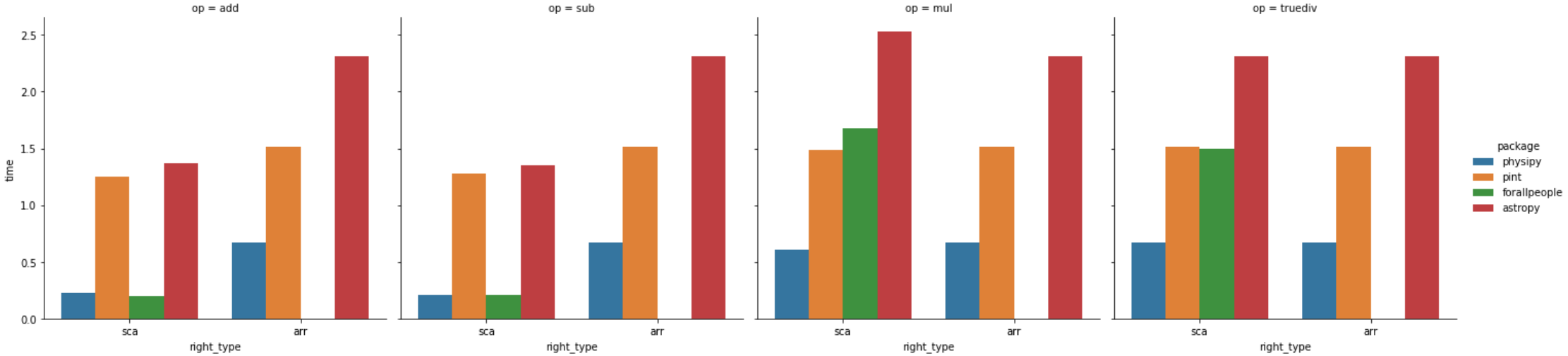
What is measured
The script compares the libraries on two axes:
- Capability — which operations each library actually supports (unary and binary operators, numpy ufuncs, and numpy functions), discovered by trying each operation and catching failures. This is a qualitative comparison, not a timing.
- Speed — time per call for a curated set of common operations, reported in
microseconds and relative to the raw-numpy baseline (
×numpy), for both scalar and array (length 1000) values.
Binary operations are exercised against three operand relationships (an idea borrowed from quantities-comparison):
| Relationship | Example | What it exercises |
|---|---|---|
same |
meter + meter |
plain arithmetic |
compatible |
meter + mile |
same dimension, unit conversion |
different |
meter + second |
different dimension |
Each timing is the best of several timeit repeats, with the number of inner
loops chosen automatically.
Reproduce
uv sync --group benchmark      # installs pint, astropy, forallpeople, ...
uv run python benchmarks/compare_packages.py
# options: --size N  --repeat R  --csv PATH  --plot PATH  --no-plot
It prints the tables below, writes a timings CSV and a capability CSV, and saves the chart.
Results
!!! note
Microbenchmark on a single machine — read the numbers as relative
comparisons (the ×numpy column), not absolute throughput. Re-run locally
for your own hardware and library versions.
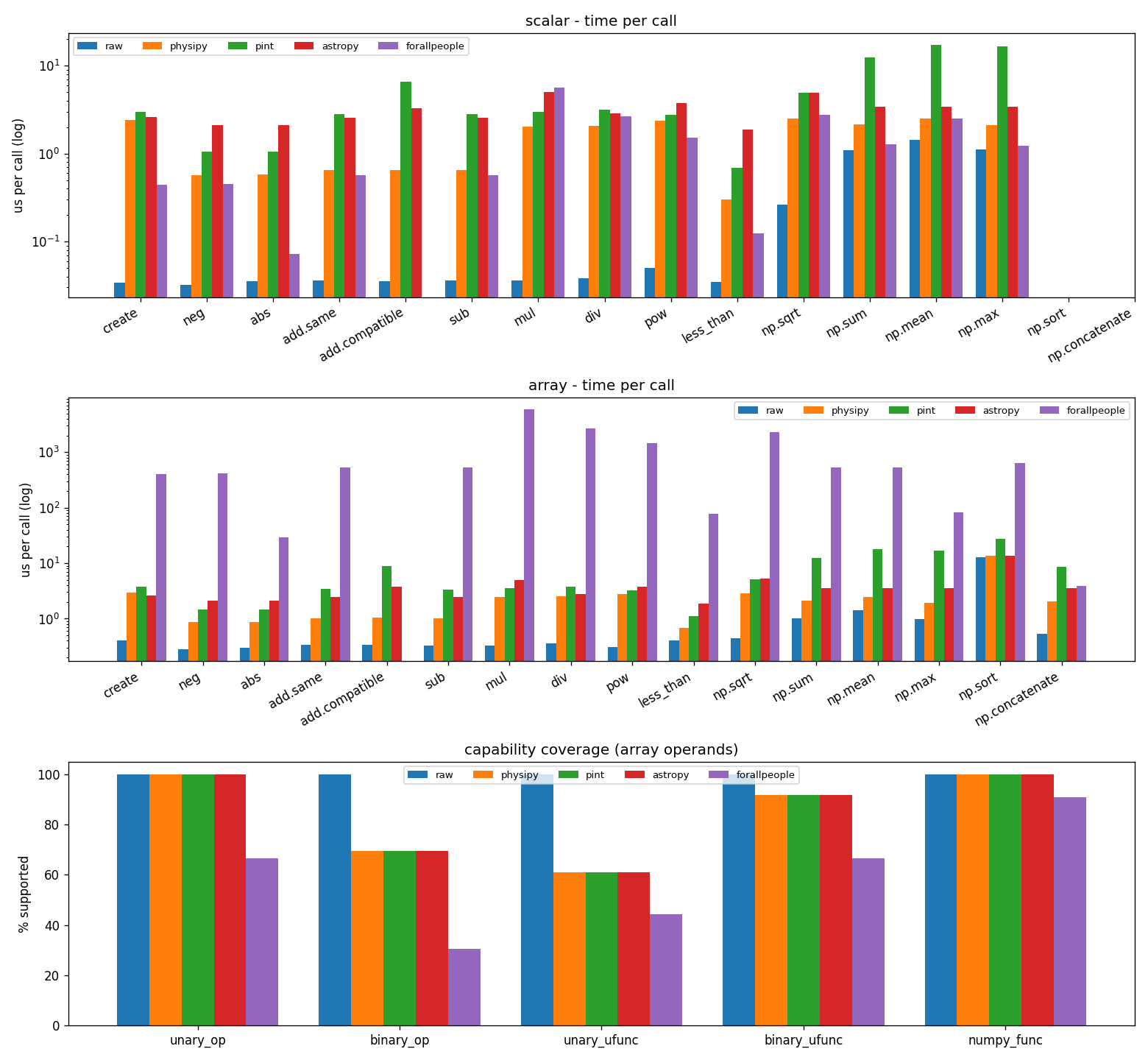
Capability (supported / total)
How many operations of each category each library accepts on array operands:
library            unary_op     binary_op   unary_ufunc  binary_ufunc    numpy_func
raw               3/3          36/36         18/18         12/12         11/11
physipy           3/3          25/36         11/18         11/12         11/11
pint              3/3          25/36         11/18         11/12         11/11
astropy           3/3          25/36         11/18         11/12         11/11
forallpeople      2/3          11/36          8/18          8/12         10/11
physipy, pint and astropy share an essentially identical capability profile.
The "missing" unary ufuncs are transcendental functions such as exp, log
and sin applied to a length: these are correctly rejected as
dimensionally invalid (a feature, not a gap). forallpeople, being
scalar-oriented, supports far fewer operations.
Timing — arrays (length 1000)
Time per call, µs and ×numpy overhead:
operation                      raw           physipy              pint           astropy      forallpeople
create                0.411 x    1      2.957 x    7      3.720 x    9      2.605 x    6    408.723 x  994
neg                   0.280 x    1      0.869 x    3      1.480 x    5      2.084 x    7    418.799 x 1496
abs                   0.295 x    1      0.880 x    3      1.486 x    5      2.094 x    7     28.849 x   98
add.same              0.340 x    1      1.029 x    3      3.427 x   10      2.475 x    7    531.605 x 1563
add.compatible        0.333 x    1      1.048 x    3      8.752 x   26      3.719 x   11               N/A
sub                   0.328 x    1      1.022 x    3      3.364 x   10      2.436 x    7    530.913 x 1621
mul                   0.329 x    1      2.465 x    7      3.575 x   11      4.929 x   15   5933.254 x18007
div                   0.364 x    1      2.516 x    7      3.763 x   10      2.773 x    8   2658.620 x 7312
pow                   0.306 x    1      2.753 x    9      3.257 x   11      3.801 x   12   1477.430 x 4829
less_than             0.400 x    1      0.683 x    2      1.109 x    3      1.855 x    5     78.385 x  196
np.sqrt               0.447 x    1      2.823 x    6      5.197 x   12      5.206 x   12   2331.691 x 5214
np.sum                1.023 x    1      2.102 x    2     12.499 x   12      3.579 x    3    524.820 x  513
np.mean               1.422 x    1      2.473 x    2     17.663 x   12      3.503 x    2    536.508 x  377
np.max                0.971 x    1      1.954 x    2     16.857 x   17      3.523 x    4     81.995 x   84
np.sort              12.619 x    1     13.681 x    1     27.756 x    2     13.417 x    1    640.278 x   51
np.concatenate        0.542 x    1      2.040 x    4      8.661 x   16      3.506 x    6      3.869 x    7
Timing — scalars
operation                      raw           physipy              pint           astropy      forallpeople
create                0.034 x    1      2.402 x   71      3.003 x   89      2.593 x   77      0.446 x   13
neg                   0.032 x    1      0.569 x   18      1.064 x   33      2.121 x   67      0.449 x   14
add.same              0.036 x    1      0.657 x   18      2.840 x   79      2.572 x   71      0.572 x   16
add.compatible        0.035 x    1      0.652 x   19      6.649 x  189      3.300 x   94               N/A
mul                   0.036 x    1      2.023 x   56      2.995 x   83      5.025 x  139      5.645 x  156
np.sum                1.102 x    1      2.136 x    2     12.450 x   11      3.412 x    3      1.275 x    1
np.sqrt               0.263 x    1      2.528 x   10      4.968 x   19      4.977 x   19      2.765 x   10
Chart
Takeaways
- physipy has the lowest overhead of the unit libraries on essentially every operation — typically 2–7× numpy on arrays, where pint and astropy are often 2–4× higher.
- The
compatiblerelation exposes unit-conversion cost:add.compatible(meter + mile) pushes pint from 10× to 26× numpy and astropy from 7× to 11×, while physipy stays at 3× because it normalises to SI at construction. - forallpeople is scalar-oriented: on arrays it builds object arrays of
scalar
Physicals, so array operations are 100–18000× slower — fine for engineering scalars, unsuitable for array workloads. - numpy reductions (
sum,mean,max) are cheap in physipy and astropy (2–4× numpy) but markedly slower in pint (12–17×).
See also the airspeed-velocity benchmarks, which track physipy's own performance over time.
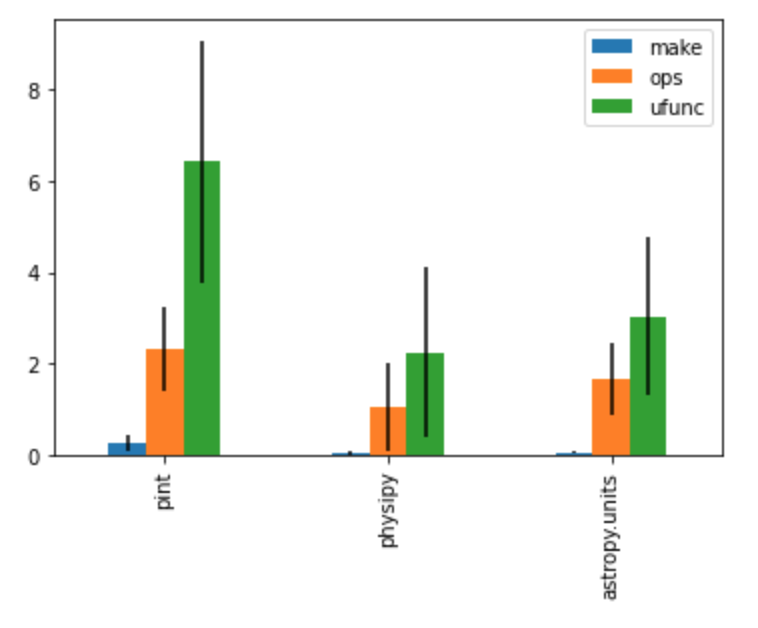
For an additional in-depth, reproducible comparison, see mocquin/quantities-comparison:
The full landscape
Many more packages exist (roughly by popularity): astropy · sympy · pint · forallpeople · unyt · python-measurement · Unum · scipp · magnitude · numericalunits · buckingham · quantities · brian · quantiphy · pynbody · pyansys-units · natu · misu · openscm-units · and pysics, from which physipy was originally inspired.
If you know another package not listed here, contributions are welcome. For broader context on the topic, see the quantities-comparison repo, this talk, and this comparison table.
There are C/C++ alternatives too, such as units.